
“Over two thousand years, the study of collateral diseases has lacked a systematic framework—a long-unresolved gap in the theoretical system of traditional Chinese medicine.” Recently, the new book release conference for LuoXue Integration, an academic monograph of over 7 million characters edited by Academician Wu Yiling, alongside a symposium on collateral disease academic thought, was held in Beijing. The newly released LuoXue Integration consists of four volumes: Collateral Disease Theory, Clinical Practice of Collateral Disease, Collateral-Regulating Formulas and Medicinals, and Collateral-Regulating Health Preservation. It achieves a comprehensive and systematic synthesis of collateral disease theory, clinical practice, formulas and medicinals, and health preservation.
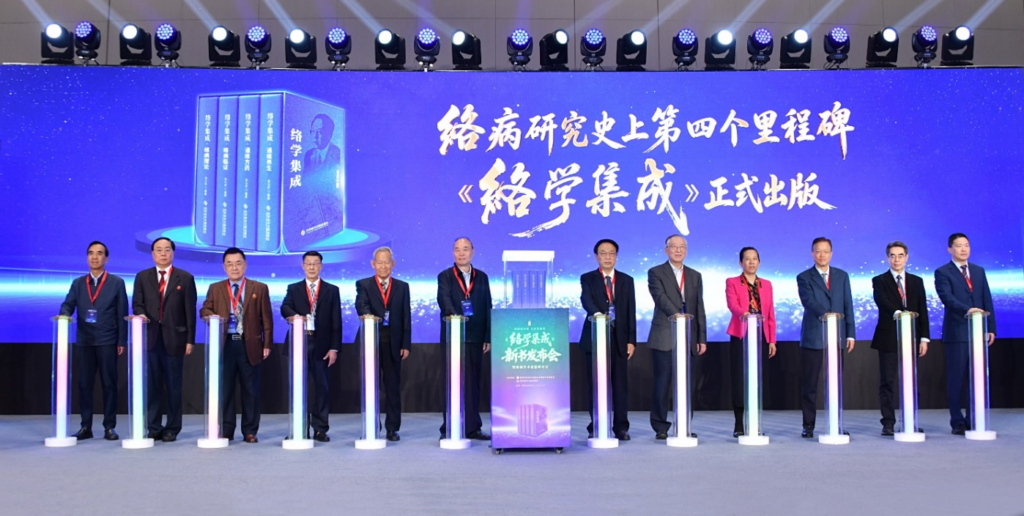
The new book release conference for LuoXue Integration and the symposium on collateral disease academic thought take place
The theory of collateral diseases has a long history, originating in the Huangdi Neijing (Yellow Emperor’s Inner Canon) and being continuously enriched and developed by Zhang Zhongjing of the Eastern Han Dynasty and Ye Tianshi of the Qing Dynasty. However, constrained by the ancient academic tendency to “emphasize the meridians and neglect the collaterals,” along with limited scientific and technological conditions, research on collateral disease throughout history remained fragmented and unsystematic. Consequently, a complete and standardized theoretical system was never established, making this a long-standing unresolved academic issue in the history of TCM development.
The first Master of TCM, Professor Lu Zhizheng, praised this work as the “fourth milestone” in the history of collateral disease research, following the Huangdi Neijing, Zhang Zhongjing, and Ye Tianshi. The project “Construction and Innovative Transformation of the TCM Collateral Disease Theoretical System” has been selected for inclusion in the Chinese Academy of Engineering and Major National Engineering Projects.
Academician Wu Yiling’s team broke free from traditional research models and pioneered an integrated model for academic innovation and transformation in TCM, combining “theory + clinical practice + new drugs + experimentation + evidence-based medicine.” This led to the development of several innovative patented TCM drugs, including Tongxinluo Capsules, Shensong Yangxin Capsules, and Qili Qiangxin Capsules, which are widely used in the prevention and treatment of major chronic diseases such as cardiovascular and cerebrovascular diseases, diabetes, and respiratory diseases. Related research findings have been published in top-tier international journals such as the Journal of the American Medical Association (JAMA) and the European Heart Journal.
During the keynote session of the conference, Academician Wu Yiling, Professor Yang Yuejin from Fuwai Hospital of the Chinese Academy of Medical Sciences, Professor Huang Congxin from Renmin Hospital of Wuhan University, Professor Li Xinli from the First Affiliated Hospital of Nanjing Medical University, and Professor Jia Zhenhua from the Hebei Institute of Collateral Disease Innovation and Medicine delivered academic reports. They engaged in in-depth discussions on the unique value of collateral-dredging medications in the prevention and treatment of major diseases, including cardiovascular and cerebrovascular diseases, diabetes, tumors, and respiratory diseases.
At the conference, Academician Wu Yiling presented copies of the book to the National Museum of Traditional Chinese Medicine, as well as to representatives from multiple universities and academic societies in Beijing, Tianjin, Guangdong, Liaoning, Guangxi, Hunan, Fujian, and other regions.